As part of engagement activities in Tenerife, elementary schools participated in educational workshops framed within the OCEAN CITIZEN project, focused on Canarian marine forests, their diversity in colours and shapes, and the essential role they play in maintaining healthy oceans.
In first and second grade, kids learned to separate marine from land forests and distinguish animals inhabiting marine forests from those swimming in the open ocean. From third to fifth grade, games led the students to tell marine forests apart from the rest of marine ecosystems, and place marine forest inhabitants in the correct home: seagrass, intertidal algae, or sponges.
Sixth graders took it one step further and discovered a key element behind a restoration project such as OCEAN CITIZEN: the type of seabed each forest needs to develop and, therefore, be replanted. Through games, students learned that many species require a hard substrate, such as volcanic rock in the Canary Islands, and that without this substrate, scientists cannot proceed with replanting. This learning process made it easier to understand the key role artificial reefs play in many marine restoration projects, as they provide a valuable hard substrate for certain forms of life to recover.
Building on this introduction, and to bring the concept of ecological restoration into the classroom in a tangible way, the activity was complemented by a hands-on experiment. This is where the BiodivOcean project and its methodology was introduced and applied with the participating schools.
The BiodivOcean project introduces restoration concepts through a practical citizen science activity, allowing students to directly observe ecological succession through biofilm formation and to better understand how restoration processes work in real marine environments.
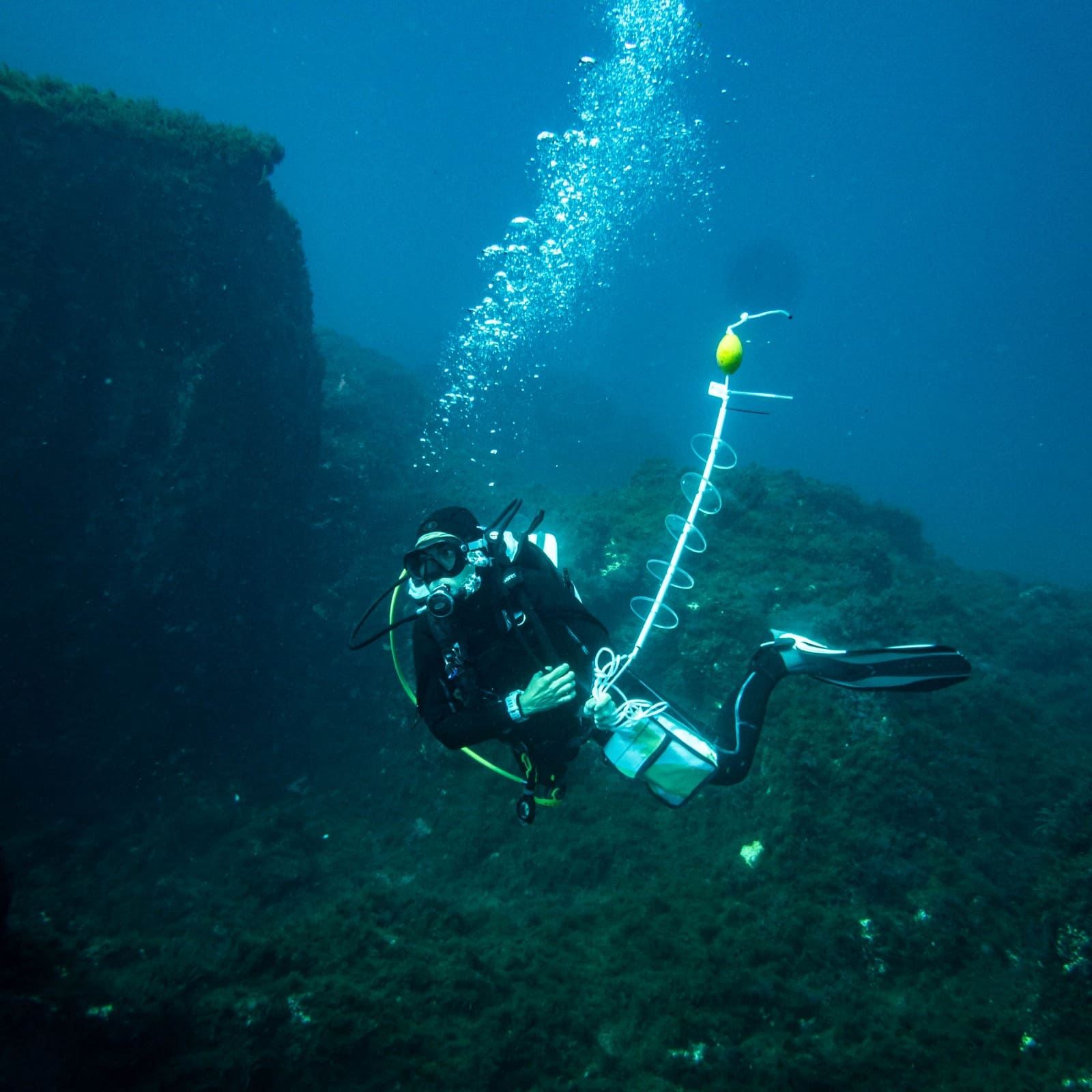
The BiodivOcean project uses the VIRTUE method, which is quite simple: a small structure containing 10 acrylic discs, known as a Rack, is installed underwater and collected after approximately five months. Before deployment, a clean rack was brought to the classroom so students could become familiar with the structure and understand how the experiment would work. Once submerged, the Rack will later be brought back to the classroom for observation under a microscope, allowing students to see the life that has developed on the discs. This hands-on experiment illustrates the concept of ecological succession, which begins with the formation of a biofilm.


One of the advantages of the VIRTUE method is its flexibility, which allowed us to adapt the experiment and co-create our own rack. We added our own touch by creating ceramic discs to compare how colonisation occurs on different substrates. Two racks have been deployed beneath the docks of Amarilla Marina, at 1 meter depth, and a third one at 15 meters depth, next to one of Submarine Safaris’ marking buoys that scuba divers can easily locate.
This wouldn’t have been possible without the precious help of the local dive center GooDiving, whose team is periodically sending photographs of the submerged racks. Students, and yourself, can follow the colonisation process through this link. While these updates provide a general overview, the detailed observation will take place once the discs are retrieved and analysed in the classroom. We’re just as excited as the kids and looking forward to seeing marine life developing and growing on our small underwater experiments.